London & a Wedding at Coworth Park
A week of Churchill, spies, martinis and markets in London — headquartered at Raffles London at The OWO on Whitehall — then out to the Berkshire countryside for THE WEDDING at Coworth Park before flying home Sunday. John "Rowdy" Rowzee joins us Saturday the 8th. And because George is the resident history buff, every day carries a 📜 history brief — this is a city with two thousand years of stories underfoot, and we're sleeping in one of them.
Booking checklist
- Buckingham Palace State Rooms — open 9 Jul–27 Sep 2026; timed tickets sell out. Book Sun 9 Aug slot now (£33 advance).
- Windsor Castle — prebook Fri 14 Aug (£32 advance).
- Churchill War Rooms — timed entry, prebook Mon 10 Aug.
- Kioku by Endo rooftop dinner & Rules — reserve both.
- London Eye — timed slot for Sun 9 Aug.
- Highgate Cemetery guided tour & afternoon tea at Kensington Palace — both timed, Tue 11 Aug.
- Luminescence — ✓ already ticketed for Sat 8 Aug.
- Falconry at Coworth Park — book through the hotel concierge.
Two small flags
- Flight times: AA 136 leaves LAX Thu 6 Aug at 4:30 p.m. and is scheduled to land Heathrow at 11:05 a.m. Friday 7 August (overnight eastbound). Worth double-checking the booking confirmation.
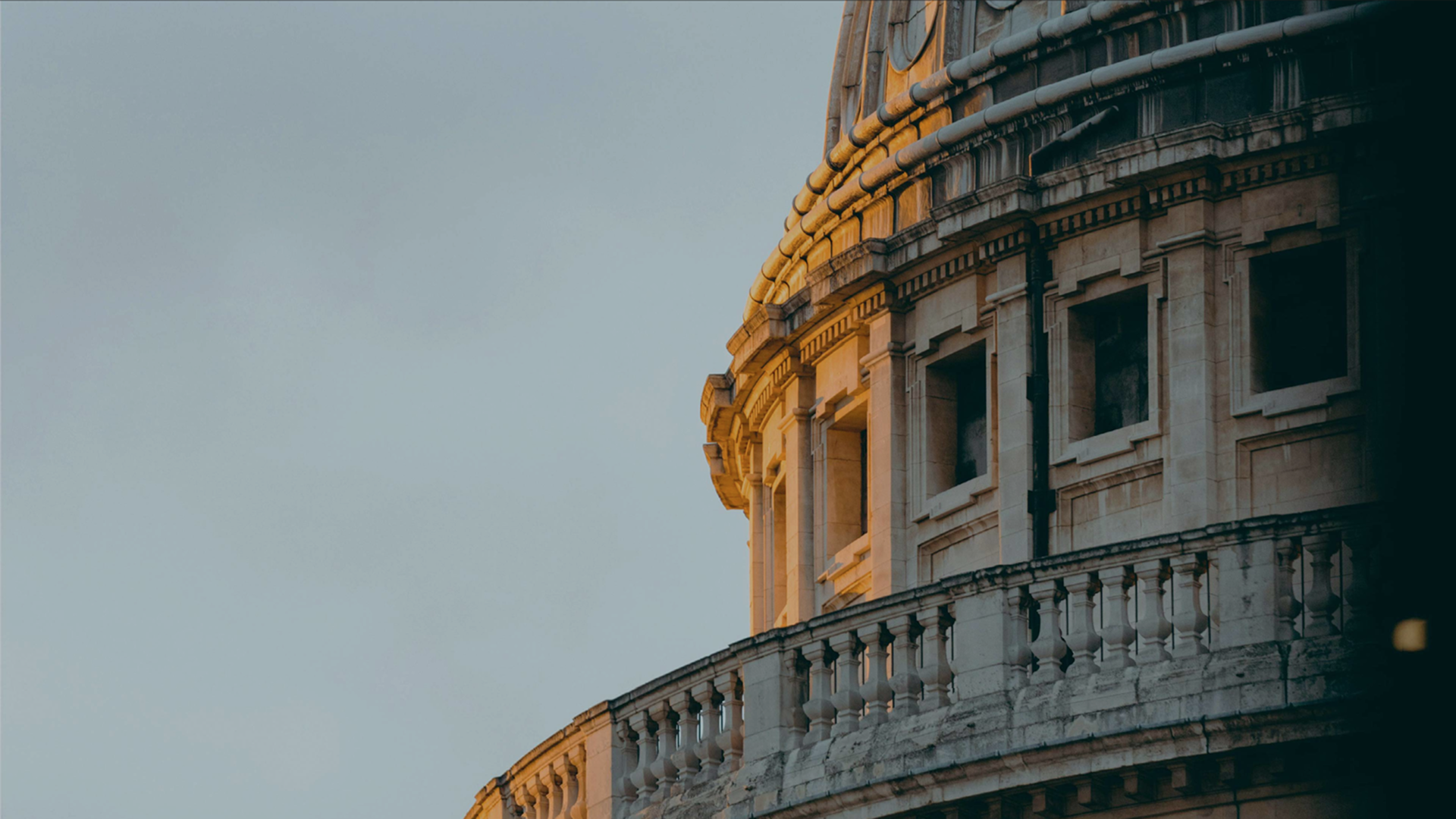
- Luminescence is staged at Westminster Cathedral (Victoria Street) — the great Byzantine-style Catholic cathedral — not Westminster Abbey. About a 15-minute walk from the Abbey; easy Uber from the hotel.
Wheels Up — LAX → London
The adventure begins with champagne in the Flagship Lounge and an overnight hop across the Atlantic.
- ~1:30 p.m.
Meet in the Flagship Lounge
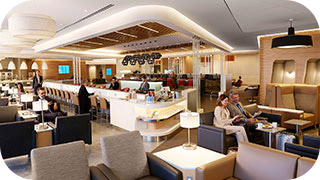
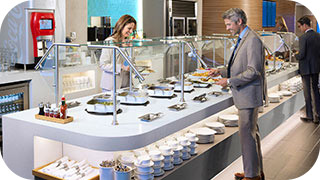
We rendezvous in American's Flagship Lounge at LAX (Terminal 4, airside). Quiet corners, showers, a proper buffet with chef-inspired dishes, and self-serve champagne — the correct way to start a trip like this. Allow time to toast the itinerary properly.
- 4:30 p.m.
American Airlines Flight 136 departs
Nonstop LAX → London Heathrow on the 777. Dinner over the Rockies, a movie, then lights out — it's an overnight flight, so sleep is the mission. Landing is scheduled for 11:05 the next morning, London time.
- Onboard
Jet-lag strategy
Set watches to London time at wheels-up. Eat early, skip the second glass of wine (debatable), and sleep as much as possible — Friday is designed to be gentle, but it ends with martinis.
Flight card
- AA 136 · LAX → LHR
- Departs Thu 6 Aug, 4:30 p.m. PDT
- Arrives Fri 7 Aug, 11:05 a.m. BST (verify against booking)
- ~10 hr 35 min nonstop
For the history buff
The field we land on tomorrow was, until 1944, the hamlet of Heath Row — orchards and market gardens flattened for a wartime RAF airfield that never saw military use. It opened to civilian traffic on New Year's Day 1946 with army tents for terminals and duckboards over the mud; within a generation it was the busiest international airport on earth. We arrive rather more comfortably than the first passengers did.
Landing Softly — The OWO, Whitehall & Mayfair Martinis
A leisurely recovery day: check into a legend on Whitehall, peek at No. 10, then a golden amble through St James's and Mayfair — Jermyn Street, Fortnum's, Savile Row, Bond Street, Berkeley Square — ending at the most famous martini trolley in the world.
- 11:05 a.m.
Land at Heathrow
Car into town (~45–60 min). Rooms may not be ready before mid-afternoon — drop bags, freshen up, and let the hotel work its magic.
- Afternoon
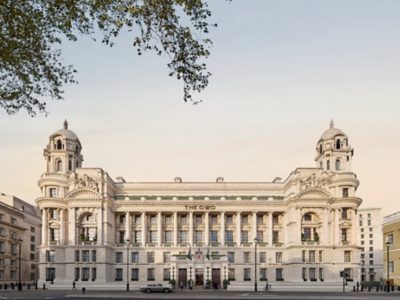
Check in: Raffles London at The OWO
See the hotel's story below — we are sleeping inside a century of British history, two minutes from Downing Street.
- Late afternoon
10 Downing Street & a Whitehall stroll
The world's most famous front door is practically next door — view the gates on Whitehall, then wander past Horse Guards and through St James's Park.
- Afternoon amble
St James's → Mayfair, the classy way
Up through St James's: Jermyn Street (shirtmakers, cheesemongers, the gentleman's mile) and Fortnum & Mason — the eau-de-nil grocer to the King since 1707; the food hall is mandatory. Cross Piccadilly through the Burlington Arcade to Savile Row, the home of bespoke tailoring (and the rooftop of the Beatles' last concert), then along New & Old Bond Street's flagships to Berkeley Square — listen for that nightingale — five minutes from the Connaught.
- ~5:30 p.m.
Martinis at the Connaught Bar
Agostino Perrone's team wheels the legendary martini trolley to the table and builds your drink to order — choose your gin, your vermouth, your bitters. Routinely ranked among the best bars on earth. No reservations for small groups; arrive at opening to snag seats.
- Evening
Dinner nearby (TBD)
Ideas within a short stroll of the Connaught: Scott's (Mount Street seafood institution), Kitty Fisher's (candlelit Shepherd Market charm), or the Mount St. Restaurant. For a nightcap fit for a history buff: Apollo's Muse, the marble-drenched cocktail lounge inside Bacchanalia at 1 Mount Street — fourteen kinds of marble and genuine Greek and Roman antiquities, including its namesake 2nd-century statue, watching you drink. (It runs largely as a members' lounge — a dinner booking at Bacchanalia is the reliable way in.) Then an early night — Saturday is a big one.
From War Office to Raffles
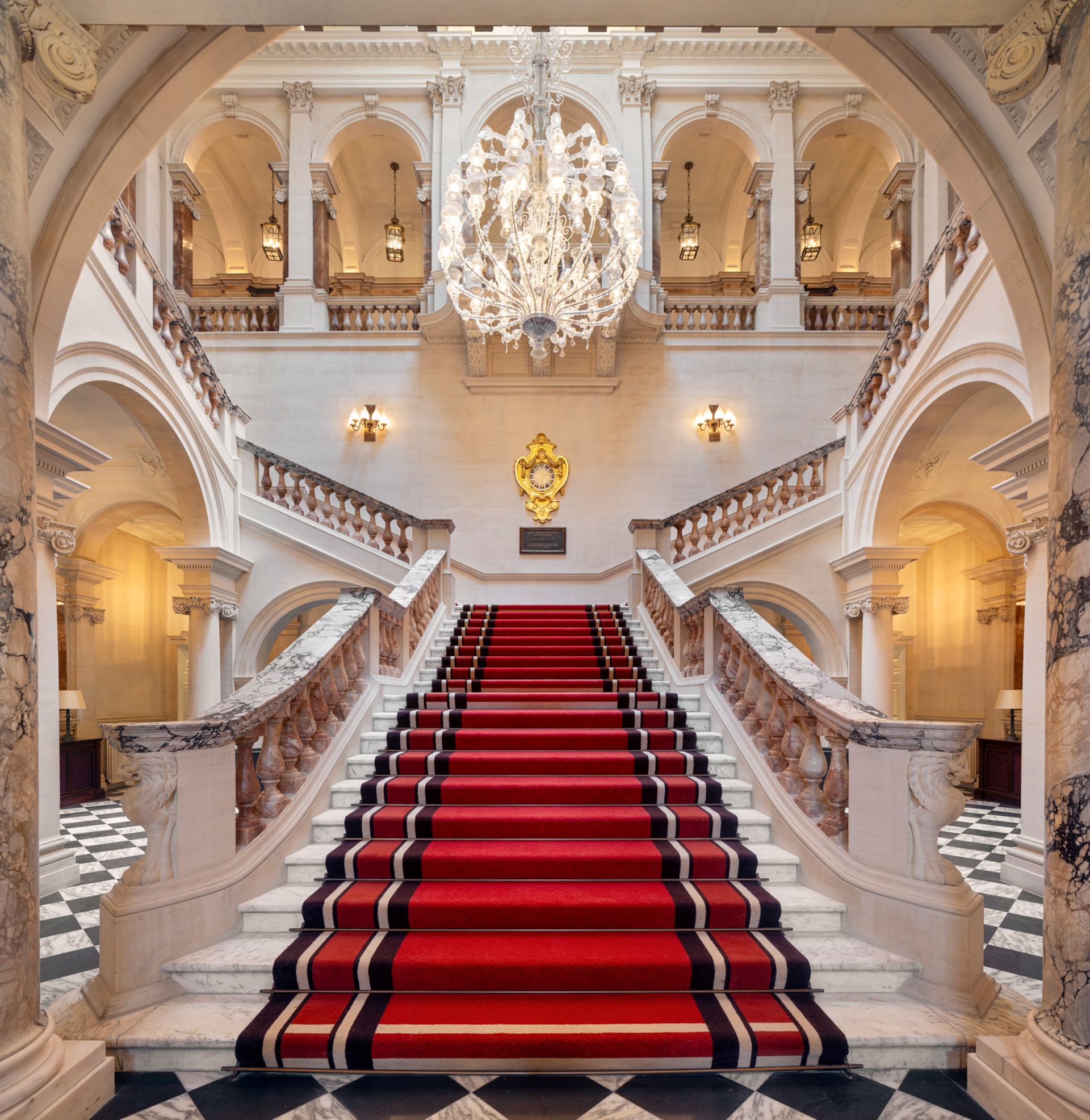
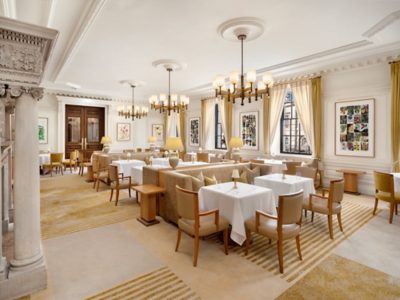
Completed in 1906 to William Young's Edwardian Baroque design, the Old War Office rose on the site of Henry VIII's Palace of Whitehall — roughly 1,100 rooms threaded along more than two miles of corridors. From his office here, Winston Churchill served as Secretary of State for War (1919–21); Lords Haldane and Kitchener walked the same marble staircase.
Spies, Bond & the rebirth
MI5 and MI6 both trace early operations to this building, and Ian Fleming — a regular visitor — borrowed its corridors for James Bond, with several 007 films shot on location. After a meticulous seven-year restoration by hundreds of artisans, it reopened in 2023 as Raffles London at The OWO: 120 rooms and suites, nine restaurants and three bars — including a certain Spy Bar in the vaults, which we visit Saturday.

For the history buff
Our whole first day happens inside vanished Whitehall Palace — at 1,500 rooms the largest palace in Europe, Henry VIII's pleasure dome of tiltyards and cockpits, until it burned to the ground in 1698. The one great survivor, Inigo Jones's Banqueting House (1622), stands directly across from Horse Guards: it was from a window of its glorious Rubens-ceilinged hall that Charles I stepped onto the scaffold on a freezing 30 January 1649 — two minutes from our lobby. Downing Street itself was thrown up in the 1680s by Sir George Downing — Harvard's second-ever graduate and a double agent who spied for both Cromwell and the restored Charles II. And "Mayfair"? Named for the riotous fortnight-long May Fair, suppressed in the 1760s when the neighbors got too grand for it.
Portobello, Ted Lasso's Richmond & a Cathedral of Light
Market treasure in the morning, football-fiction pilgrimage in the afternoon, rooftop dinner, an immersive light show — and a nightcap where spies once drank. John "Rowdy" Rowzee joins us today.

- Morning
Notting Hill & Portobello Road Market
Saturday is the market day — antiques at the Notting Hill Gate end, food stalls and vintage as you head north. Go by 9:30–10 to beat the crush, and keep an eye out for the pastel houses and the famous blue door territory of the movie.
- ~1:00 p.m.
Uber out to Richmond — believe
Forty-ish minutes to the prettiest village-in-a-city in London and the spiritual home of AFC Richmond. Walk Richmond Green (Ted's flat is on Paved Court, just off it), have a pint outside The Prince's Head — the Crown & Anchor in the show — then stroll the riverside, one of the loveliest stretches of the Thames.
- ~6:30 p.m.
Rooftop dinner at Kioku by Endo
Back at the OWO: Michelin-starred chef Endo Kazutoshi's Japanese rooftop restaurant, with panoramic views over Whitehall's rooftops toward the London Eye. Book an early table so we make the show.
- Evening
Luminescence — ticketed ✓
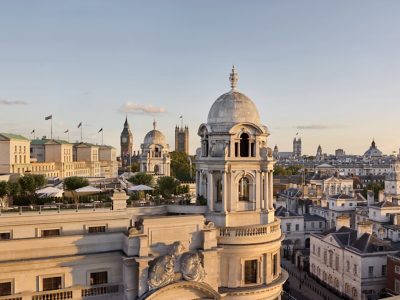
A 50-minute, 360° immersive spectacular: 24 laser projectors painting light across soaring interiors, a live choir, and narration recorded by Hugh Bonneville. Note: it's staged at Westminster Cathedral on Victoria Street — the striped Byzantine-style Catholic cathedral — not the Abbey. Ten minutes by car from the hotel; doors open 20 minutes before showtime.
- Nightcap
The Spy Bar
Down into the OWO's vaults, where military intelligence once kept its secrets: "home of cocktails & espionage — photography forbidden." The perfect debrief with Rowdy.


For the history buff
Portobello Road was a lane to Porto Bello Farm, named in patriotic fever after Admiral Vernon captured Porto Bello, Panama, from Spain in 1739; the antiques trade only arrived in the 1940s. Richmond is a Tudor stage set: Henry VII built Richmond Palace on the Green in 1501 and named it for his Yorkshire earldom — the whole London district is named after the palace, not the other way round. Elizabeth I died there in March 1603, ending the Tudor line; the old palace gateway, bearing Henry's arms, still stands beside the Green where Ted Lasso's pitch-side pub now trades. Tonight's venue, Westminster Cathedral (1895–1903), is London's great Byzantine surprise — built in striped brick and Portland stone on the site of a Victorian prison, its upper vaults still bare black brick awaiting mosaics that may take another century. The light show imagines them finished.
Buckingham Palace, Parliament & Down the Thames to Greenwich
Throne rooms in the morning, Westminster Abbey and a spin on the London Eye at midday, then a river cruise under Tower Bridge to stand astride the line where every day on Earth begins.
- Morning
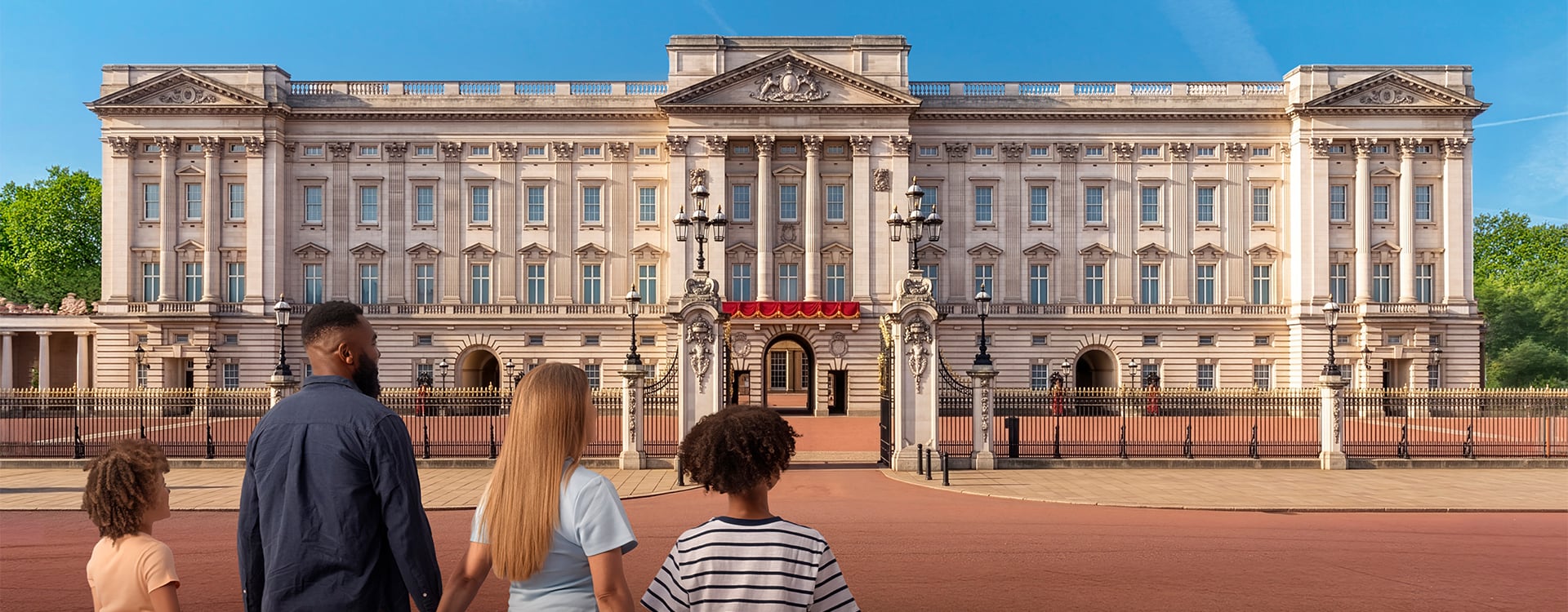
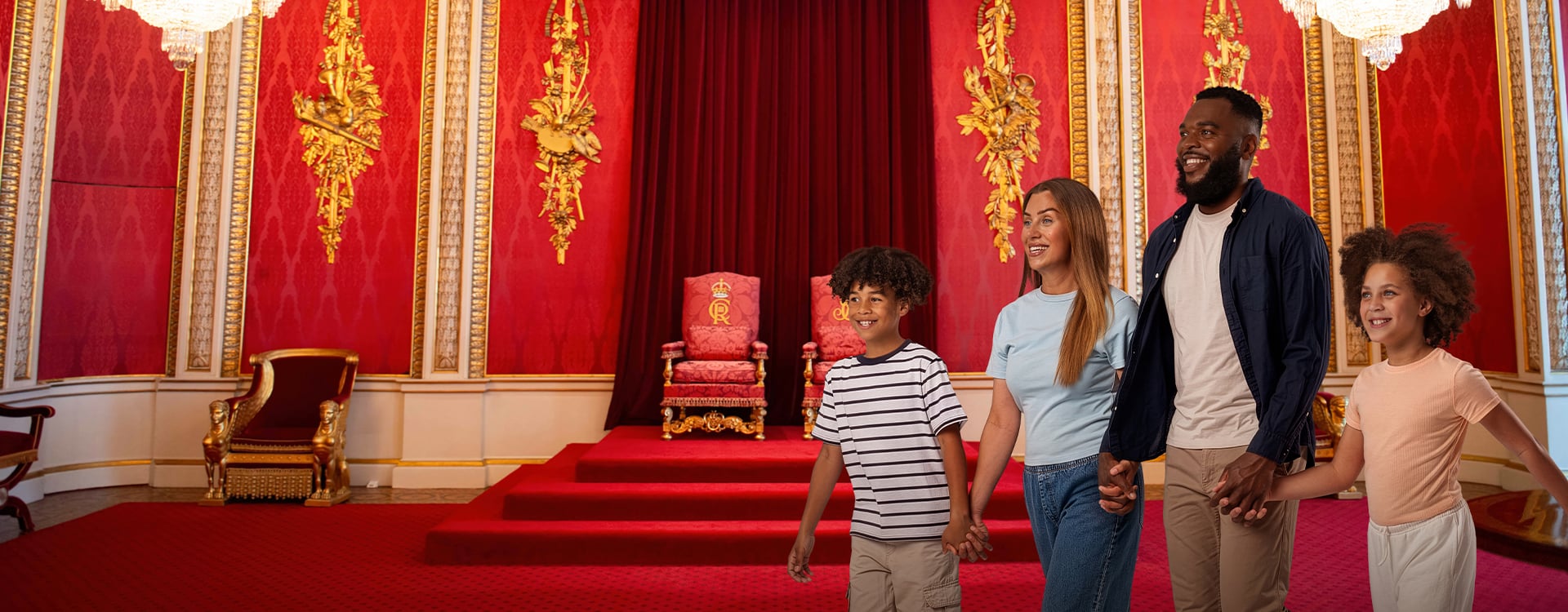
Buckingham Palace State Rooms tour
With Rowdy in tow: the 19 State Rooms the Royal Family uses for official occasions — the Throne Room, the White Drawing Room, the Grand Staircase and masterpieces from the Royal Collection. Timed entry (£33 advance); allow about 2–2.5 hours.
- Midday
Westminster Abbey, Parliament & Big Ben
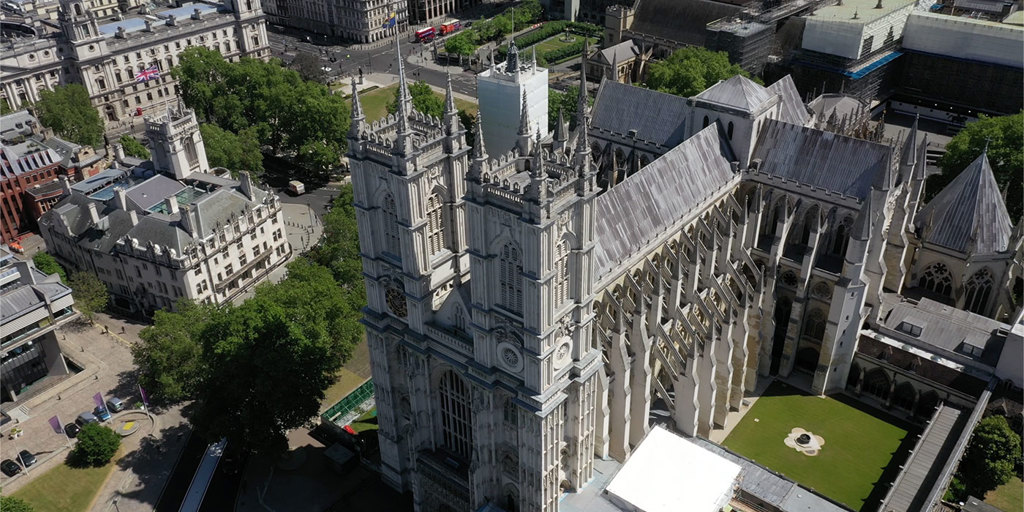
Walk down through St James's Park to Westminster. Pause at Westminster Abbey — coronation church of every monarch since 1066, resting place of Newton, Darwin and Dickens. (Sundays are worship-only: slipping into a service is free and rather wonderful; if we want the full interior tour, it's open Mon–Sat and slots neatly into Wednesday morning.) Then the classic view of the Palace of Westminster and Elizabeth Tower from Westminster Bridge.
- Early afternoon
The London Eye
Straight across the bridge to the South Bank for a 30-minute rotation on the London Eye — 25-mile views on a clear day, with everything we've been walking laid out beneath us. Book a timed slot; the pier is right below.
- Afternoon
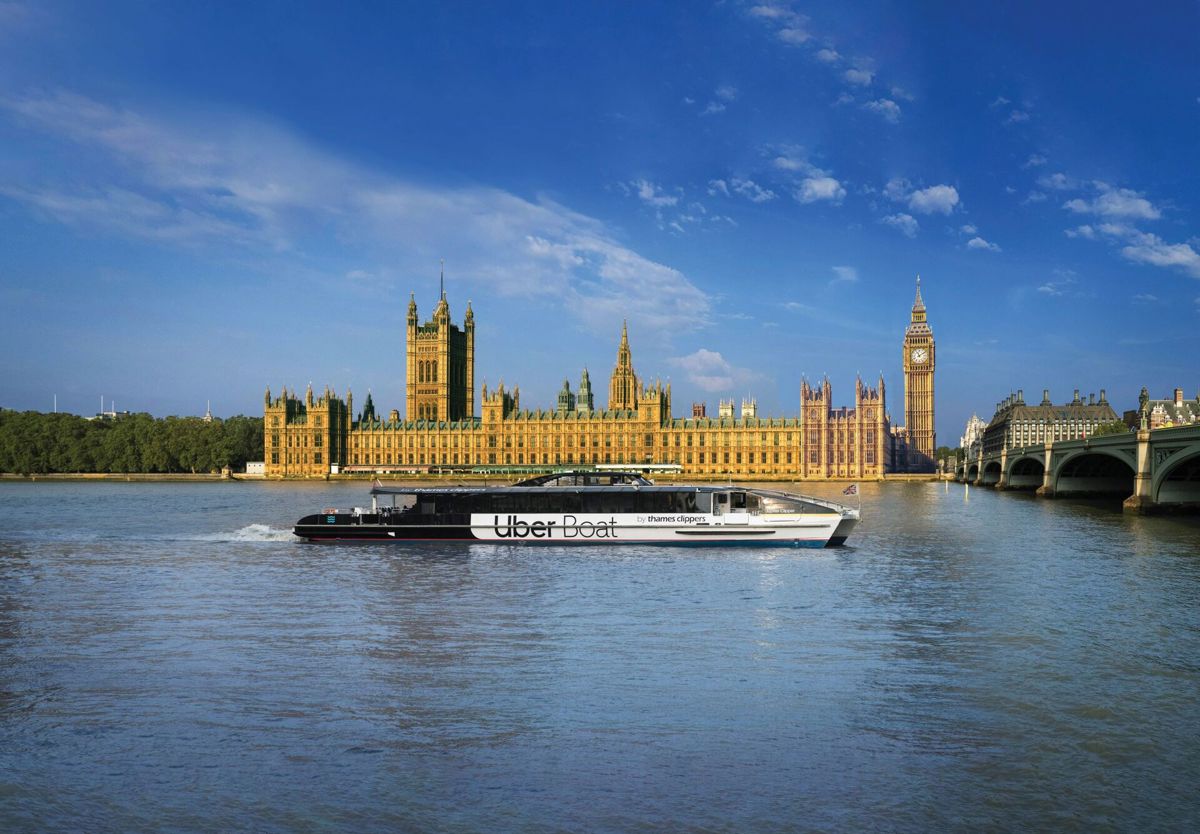
Thames cruise to Greenwich — under Tower Bridge
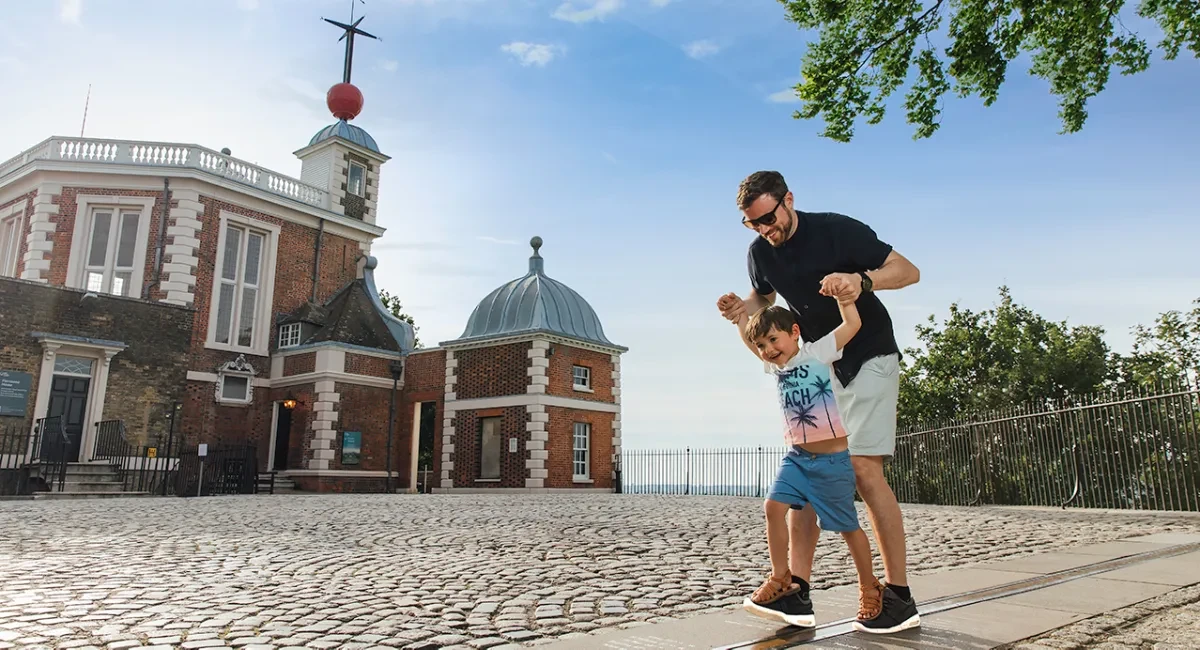
Uber Boat by Thames Clippers from the London Eye pier — past Shakespeare's Globe and the Tower of London, under Tower Bridge (the best way to see it), past Wapping — and keep an eye on the south bank at Rotherhithe for The Mayflower, the oldest pub on the Thames, where the Pilgrims' ship moored in 1620; we salute it from the water. ~50 scenic minutes to maritime Greenwich: the Cutty Sark, then into the Old Royal Naval College for the Painted Hall — "Britain's Sistine Chapel," 40,000 sq ft of swirling baroque ceiling that took Sir James Thornhill nineteen years (1707–1726) to paint, and where Nelson lay in state after Trafalgar in January 1806. Then up the hill to the Royal Observatory. Stand with one foot in each hemisphere on the Prime Meridian — longitude zero, where Greenwich Mean Time was born. Summer hours run to 7 p.m.
- Evening
Dinner (TBD)
Suggestion: stay riverside at the Trafalgar Tavern — a grand 1837 Greenwich pub where Dickens set a wedding breakfast — then boat or Uber home. Or head back and keep it easy near the hotel.
For the history buff
Buckingham Palace began in 1703 as a duke's townhouse; George III bought it in 1761 as a family retreat for Queen Charlotte, and it only became the sovereign's official residence when the 18-year-old Victoria moved in, three weeks into her reign, in 1837. Westminster Abbey has crowned every monarch since William the Conqueror on Christmas Day 1066. And Greenwich may be the most historic mile in England: the riverside lawns were the Palace of Placentia, birthplace of Henry VIII and Elizabeth I; Charles II founded the Royal Observatory in 1675 specifically to crack the longitude problem that was drowning his sailors — John Harrison's miracle clocks, which finally solved it, are displayed inside. In 1884, delegates from 25 nations meeting in Washington voted to run the world's Prime Meridian through this hilltop, which is why every clock on Earth still answers, ultimately, to Greenwich.
War Rooms, a Proper Pub Crawl & Evensong at St Paul's
Churchill's bunker by morning, Spitfires by noon, then a great historic-pub ramble: Shakespeare's Globe and the George Inn on Bankside, Fleet Street and Ye Olde Cheshire Cheese, Evensong under Wren's dome, and Bow Street, Trafalgar Square, Leicester Square and Soho — capped with dinner at the oldest restaurant in London.

- 9:30 a.m.
Churchill War Rooms
Five minutes' walk from the hotel: the underground nerve centre where Churchill and his War Cabinet ran the Second World War, left exactly as it was when the lights were switched off in 1945. Prebook the first slot; ~2 hours with the excellent Churchill Museum.
- Late morning
Imperial War Museum
Across the river in Lambeth — free entry, with the Spitfire and V-2 hanging in the great atrium. The First World War galleries and Holocaust galleries are world class; be selective, it's vast.
- Early afternoon
Bankside: Shakespeare's Globe & the George Inn
From the IWM, hop to the river and walk the South Bank past Shakespeare's Globe — the faithful oak-and-thatch reconstruction of the 1599 original, steps from where the first one stood. Detour into Borough for the George Inn, London's last surviving galleried coaching inn (1677) — Dickens drank here and put it in Little Dorrit. Walk-by or quick half; we're pacing ourselves.
- Mid-afternoon
Millennium Bridge, Fleet Street & Ye Olde Cheshire Cheese
Cross the Millennium Bridge to St Paul's, then stroll Fleet Street — old newspaper row, where every great British paper once thundered off the presses. Slip through the gateway into Middle Temple: one of the four ancient Inns of Court, a hidden world of gas-lit lanes, collegiate courtyards and gardens running down to the Thames. Its Elizabethan Middle Temple Hall (1573), under a magnificent double hammerbeam roof, hosted the first recorded performance of Twelfth Night in 1602 — quite possibly with Shakespeare in the cast — and the round Temple Church next door was built by the Knights Templar in 1185. Then duck down the alley to Ye Olde Cheshire Cheese (rebuilt 1667): gloomy, sawdusty and perfect — Dr Johnson, Dickens and Twain all drank in its vaults.
- Optional detour
The Slow Horses pilgrimage: Slough House & Blake's grave
For the Jackson Lamb faithful — ten minutes north of St Paul's up Aldersgate Street, opposite Barbican station, stands the grimy doorway used as Slough House in the series (suitably unmarked; you'll know it by the disappointment). Herron's failed spies trudge these exact Barbican streets. Five minutes further, in Bunhill Fields burial ground off City Road, is William Blake's grave — the clandestine meeting spot from the Season 1 finale, and a genuine literary shrine besides (Defoe and Bunyan lie nearby). Loop back down for Evensong; total detour ~45 minutes at Lamb's shuffling pace, less if you've had fewer cigarettes.
- 5:00 p.m.
Evensong at St Paul's Cathedral
Back up Ludgate Hill for choral evensong under the dome — free to attend, about 45 minutes, and one of the most transporting things you can do in London. Arrive by 4:40 for a seat under the crossing.
- Early evening
Covent Garden, Bow Street & the West End squares
West to the Covent Garden piazza and market halls, then Bow Street — the Royal Opera House on one side, and the site of the old magistrates' court that gave the world the Bow Street Runners, London's first police force. Pub roll-call as we go (walk-bys unless thirst dictates otherwise): the Lamb & Flag (1772, up its fighting alley — Dickens's local), the Harp (tiny, glorious), then through Trafalgar Square (Nelson, the lions, the National Gallery steps) and Leicester Square into Soho for the Dog & Duck (1897 glazed-tile jewel — Orwell's local) and the French House (half-pints only; De Gaulle's wartime HQ-in-exile).
- Evening
Dinner at Rules (and a rooftop nightcap?)
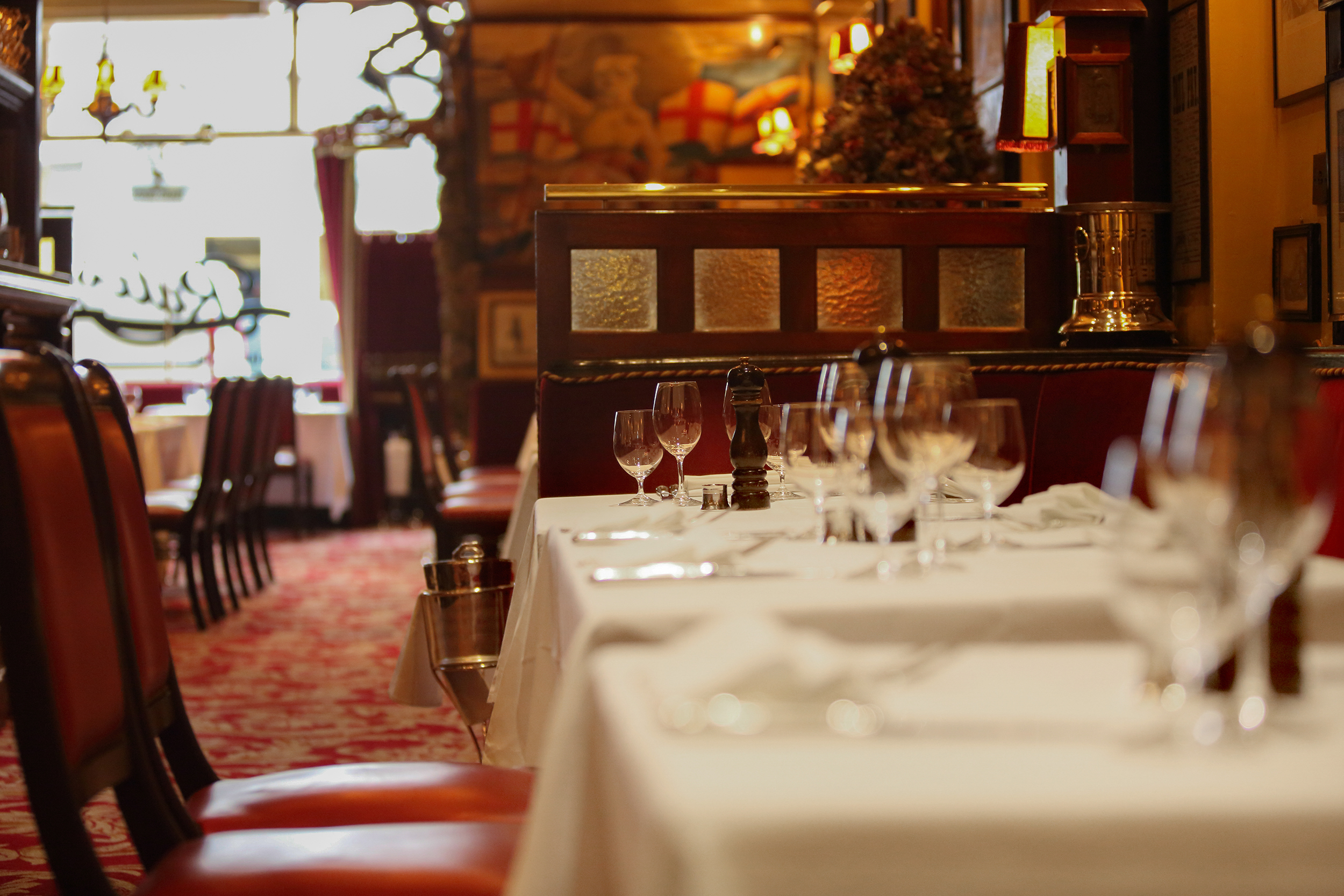
Rules, Covent Garden — opened 1798, London's oldest restaurant: game, oysters, claret and red-velvet Edwardian glamour. Excellent instinct; book it. Afterwards: good news — the El Fenn rooftop pop-up is confirmed for our dates (25 June–31 August 2026). Marrakech's legendary El Fenn takes over Flute, the rooftop bar at Broadwick Soho — lanterns, Moroccan cocktails (saffron, fig, hibiscus), North African DJs and skyline views. It's right in Soho, minutes from the evening's route; book a table in advance.



Pacing tip
This is the fullest day of the week — but the pub list is a walk-by list, not homework. If it needs trimming, the IWM is the flexible piece; the War Rooms, the Globe-to-Fleet-Street ramble, Evensong and Rules are the keepers. (The rest of the pub roster — Spaniards Inn, Holy Tavern, Mayflower — is folded into Sunday and Tuesday.)
For the history buff
The War Rooms went operational on 27 August 1939 — six days before Hitler invaded Poland — and when the lights were switched off in 1945, the maps, pins and sugar cubes in a bureaucrat's drawer were simply left where they lay. St Paul's is at least the fourth cathedral on this hilltop since 604 AD; Old St Paul's, one of medieval Europe's largest buildings, burned in the Great Fire of 1666, and Wren's replacement — topped out in 1710 — survived the night of 29 December 1940, the "Second Great Fire of London," only because volunteer fire-watchers smothered incendiaries on the dome while the City burned around it. Fleet Street has been printing since about 1500; Dr Johnson compiled his Dictionary in a court just behind the Cheshire Cheese. In the George Inn's galleried yard, plays were staged in Shakespeare's own day. And Bow Street's magistrates' court gave London the Bow Street Runners (1749) — founded by Henry Fielding, who wrote Tom Jones between arraignments.
Highgate, Hyde Park, Kensington, Harrods & Two Great Bars
Victorian gothic in the morning (with two legendary pub stops on the way down), royal parks, tea at Kensington Palace and retail majesty all afternoon, then martinis at the Connaught and sundowners on the Berkeley roof.

- Morning
Highgate Cemetery
Start north (30 min by Uber): London's most atmospheric Victorian cemetery — ivy-clad angels, the Egyptian Avenue, and residents from Karl Marx to George Eliot to George Michael. Open 10–5; the guided tour of the West side is the way to see it.
- On the way down
Two pub legends: The Spaniards Inn & The Holy Tavern
Five minutes from Highgate on the edge of Hampstead Heath sits The Spaniards Inn (1585) — Keats wrote here, Dickens wrote about it, and highwayman Dick Turpin allegedly hid upstairs. Then route the car back through Clerkenwell past The Holy Tavern on Britton Street, the tiny candle-lit Georgian gem long known as the Jerusalem Tavern. Walk-bys or a quick half — the day is young.
- Midday
Hyde Park & Kensington Gardens
Down to the park: the Serpentine, Rotten Row, the Diana Memorial Fountain — then west through Kensington Gardens to Kensington Palace, childhood home of Victoria and London home of the Waleses.
- ~3:00 p.m.
Afternoon tea at Kensington Palace
Tea in the palace gardens — scones, sandwiches and something sparkling at the palace's garden café-pavilion (book via Historic Royal Palaces when reserving palace tickets).
- Afternoon
Harrods & a Chelsea wander
Knightsbridge's 1905 terracotta palace — the Food Halls alone justify the visit (1.1 million sq ft; Europe's largest department store). Then amble south through Chelsea: Sloane Square, the King's Road, garden squares and mews.
- ~5:30 p.m.
Martinis at the Connaught Bar — round two
By popular demand. The trolley returns.
- Sunset
Sundowners at the Berkeley rooftop
A few minutes away in Knightsbridge, The Berkeley's rooftop — with its famous open-air pool terrace — for golden-hour drinks to close the day.


For the history buff
Hyde Park was monastery land until Henry VIII seized it from Westminster Abbey's monks in 1536 as a private deer-hunting ground; Charles I opened it to the public, and in 1851 it held the Crystal Palace and the Great Exhibition — six million Victorians came to see the future. Kensington Palace was bought by asthmatic William III in 1689 to escape Whitehall's river damp; here, before dawn on 20 June 1837, the 18-year-old Princess Victoria was woken in her nightgown to be told her uncle was dead and she was Queen. The Spaniards Inn (1585) appears in The Pickwick Papers and Dracula, and legend insists highwayman Dick Turpin's father once kept it. Even Harrods is a history lesson: Charles Henry Harrod's little 1849 grocery grew into the terracotta palace of 1905 — and its 1898 "moving staircase" was London's first escalator, with brandy offered at the top to steady the nerves.
The British Museum, Bloomsbury & Marylebone
Seven million objects in the morning, literary squares, a canal-side walk, Liberty's Tudor palace of shopping, the BBC's old local by the Langham — and a rooftop of Craig's choosing at dusk.

- 10:00 a.m.
The British Museum
Free entry, doors at 10. The hit list: the Rosetta Stone, the Parthenon sculptures, the Egyptian mummies, the Sutton Hoo treasure and the Lewis Chessmen — all under Foster's spectacular Great Court roof. (This is the anthropology-museum fix: the museum of humanity itself.) Two to three hours, then out before fatigue wins.
- Afternoon
Bloomsbury wander
The leafy squares of the Bloomsbury Group — Russell Square, Bedford Square's perfect Georgian terraces, the blue plaques of Virginia Woolf's old neighborhood — with a stop for coffee among the bookshops.
- Mid-afternoon
Marylebone village & a canal walk
West to Marylebone High Street: Daunt Books (the most beautiful bookshop in London, Edwardian oak galleries), cheese at La Fromagerie, handsome mews-lined side streets — then up to the Regent's Canal: join the towpath by Regent's Park (or start at Little Venice's painted narrowboats) and walk the leafy, waterside stretch as far as feels good. Camden Lock is ~50 minutes if we're ambitious. Slow Horses note: in Mick Herron's books, MI5 headquarters isn't Thames House at all — it's simply "Regent's Park." You'll be strolling the perimeter of the Service. Act natural; assume Lady Di Taverner has eyes on the towpath.
- Late afternoon
The George, the Langham & Liberty
Back down Portland Place past the grand old Langham hotel to The George on Great Portland Street — the BBC's storied local (Dylan Thomas and the wartime broadcasters propped up this bar). Then five minutes south to Liberty: the 1924 Tudor-revival mothership built from the timbers of two Royal Navy ships, still the most beautiful place in London to buy a scarf.
- Sunset
Rooftop sundowners — dealer's choice: Craig
Craig picks the roof. Candidates to consider: The Rooftop at Trafalgar St James (dome views of Nelson's Column), Radio Rooftop at ME London (Strand panoramas), or Aqua Kyoto off Regent Street.
For the history buff
The British Museum (founded 1753, opened 1759) was the world's first free national public museum — seeded by physician Sir Hans Sloane's bequest of 71,000 curiosities, accepted by Parliament in lieu of £20,000 to his daughters. Inside: the Rosetta Stone (seized from Napoleon's savants in 1801, the key that unlocked hieroglyphs) and the Sutton Hoo ship burial that rewrote the "Dark Ages." Bloomsbury's squares housed the Bloomsbury Group — Virginia Woolf, Keynes, Forster — who famously "lived in squares, painted in circles and loved in triangles." The Regent's Canal (1820) was John Nash's freight highway; horse-drawn barges hauled coal along today's towpath into the 1950s. And Liberty's Tudor-revival building (1924) is honest fakery with real bones — its timbers came from two broken-up Royal Navy warships, HMS Impregnable and HMS Hindustan.
The Dorchester Rendezvous → Coworth Park
Farewell Whitehall. We join the wedding party on Park Lane and roll out to a Georgian manor in the Berkshire countryside.
- Morning
Check out of the OWO
One last breakfast under the chandeliers, then bags down and a short hop across to Mayfair.
- Midday
Meet the wedding group at The Dorchester
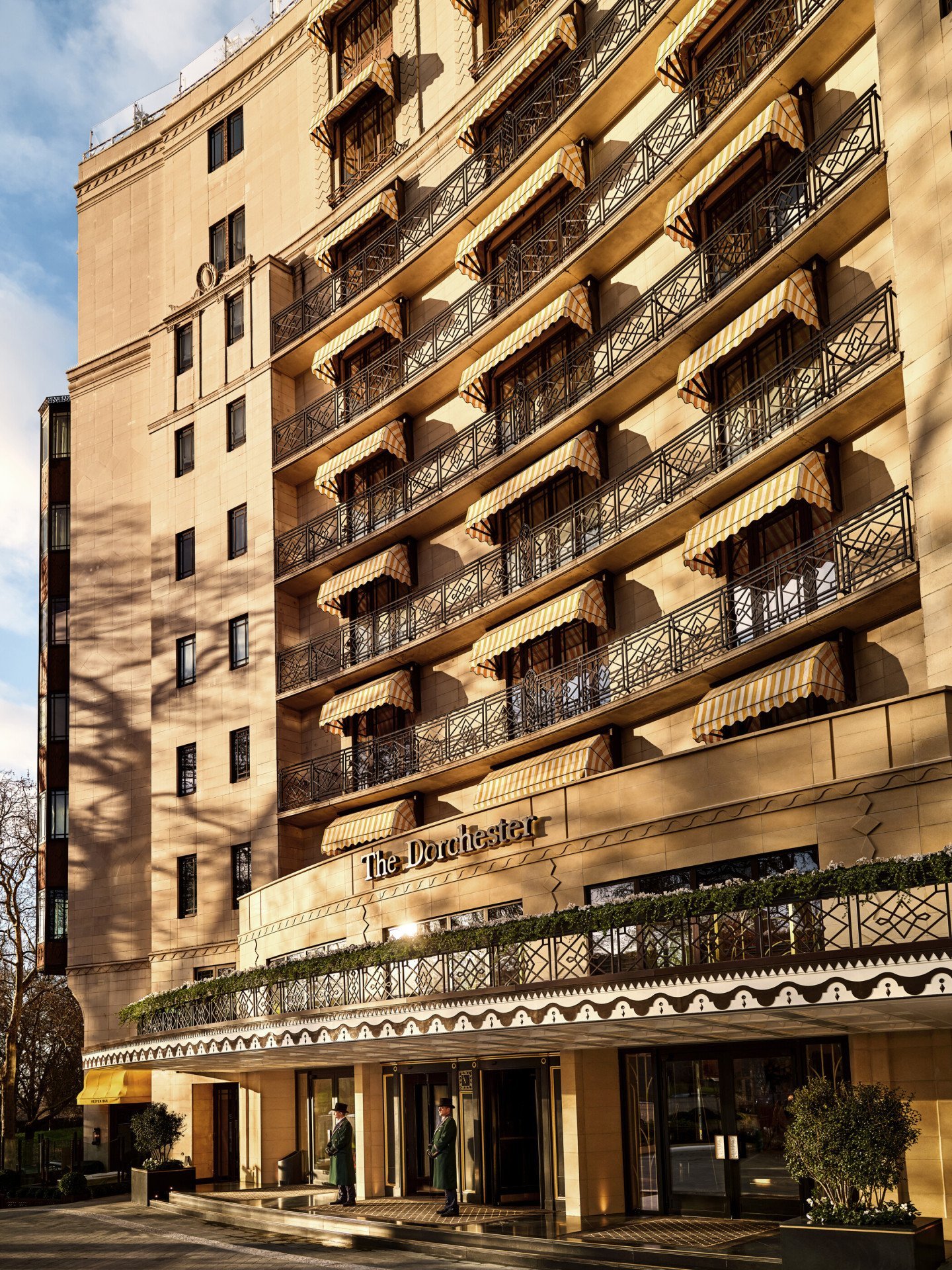
Park Lane's 1931 grande dame. Gather in The Promenade — champagne or a proper afternoon tea while the group assembles.
- Afternoon
Out to Coworth Park, Ascot
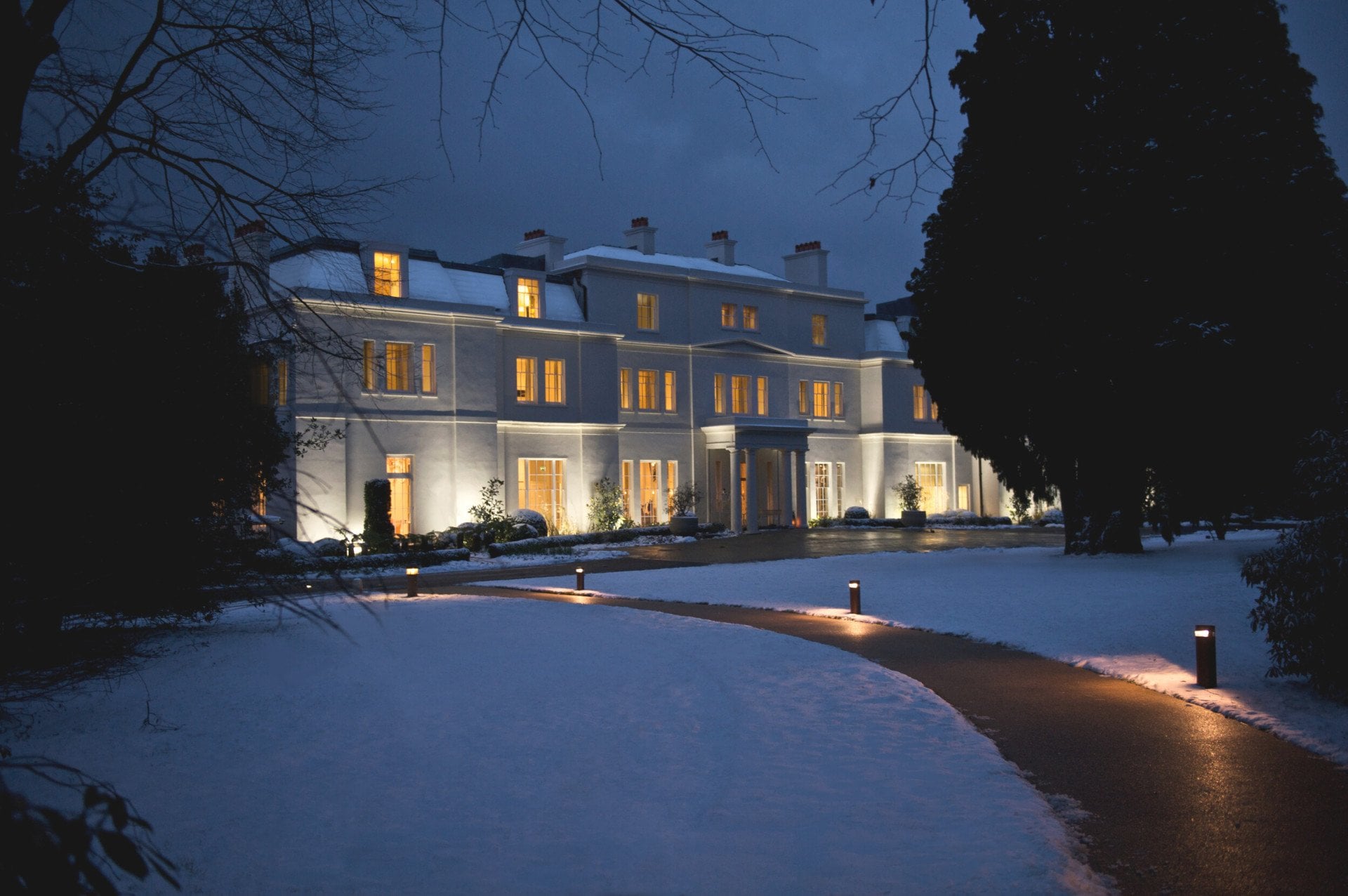
About an hour west: a Georgian mansion set in 240 acres of parkland, meadows and polo lawns — the only hotel in the UK with its own polo fields, and neighbor to Windsor Great Park. Settle in, explore the grounds, dinner with the wedding crowd. (Full background on the estate, Ascot and Windsor lives on the Coworth & Windsor page.)

For the history buff
The Dorchester (1931) was one of the first great reinforced-concrete buildings in London — so solid it was considered bomb-proof, which is why General Eisenhower took a suite here in 1944 while planning the liberation of Europe, and cabinet ministers rode out the Blitz in its basement. Coworth Park's Georgian mansion dates from 1776, on ancient manor lands hard against Windsor Great Park — a royal hunting forest for nearly a thousand years, where the ghost of Herne the Hunter (Shakespeare mentions him) is said to ride on stormy nights. Sleep well.
Windsor Castle & Hawks on the Glove
A morning in the world's oldest occupied castle, an afternoon flying birds of prey over the estate.
- Morning
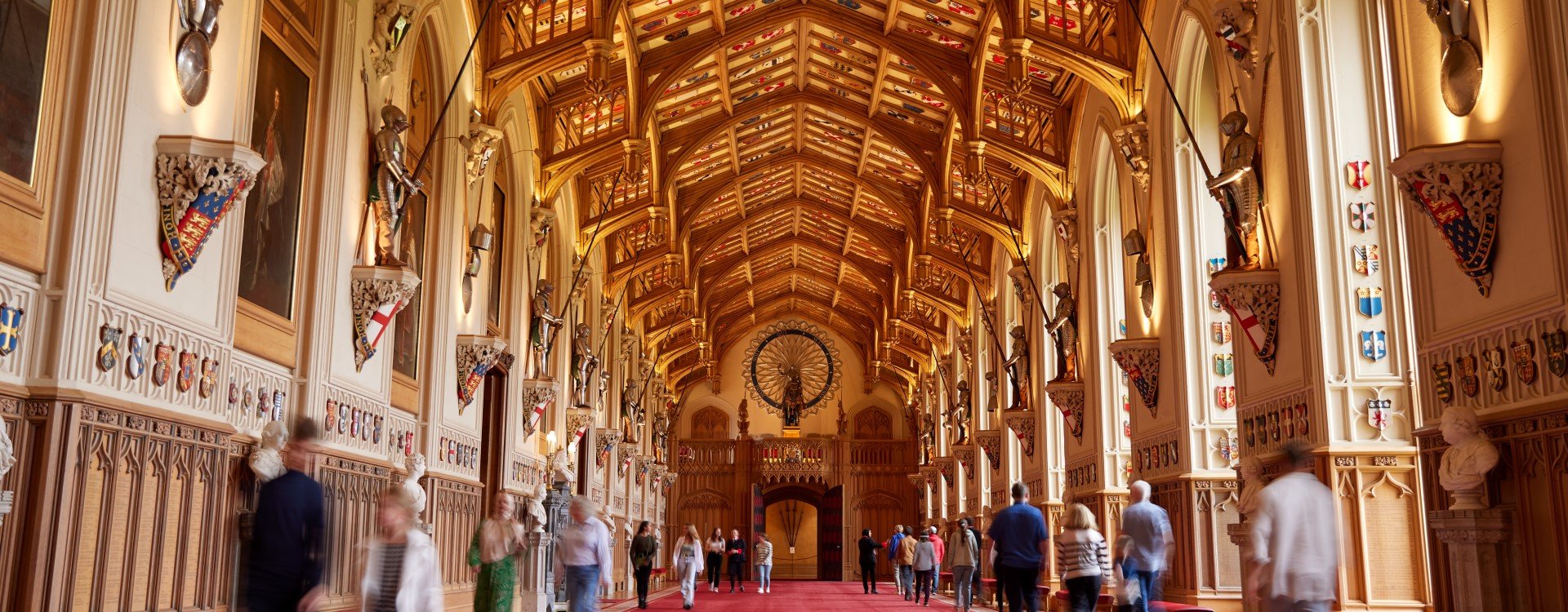
Windsor Castle tour
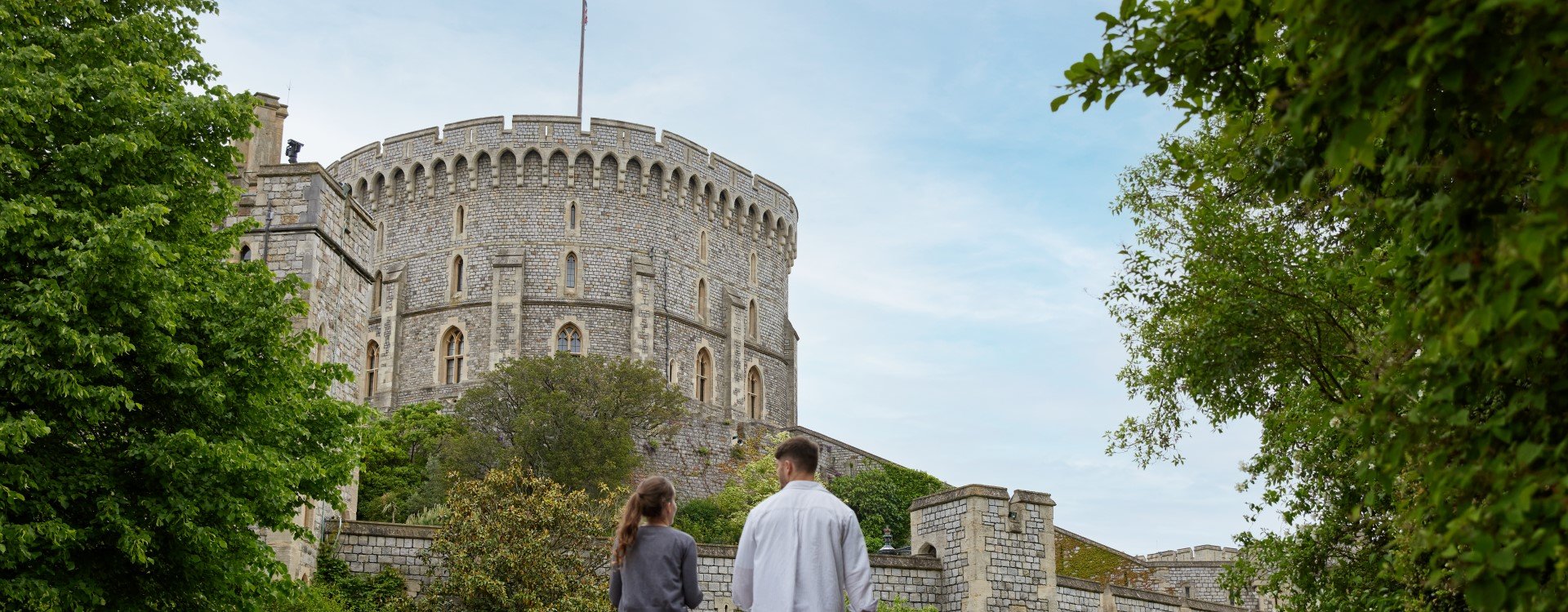
Fifteen minutes from the hotel. The State Apartments, Queen Mary's Dolls' House, and St George's Chapel — resting place of ten monarchs including Henry VIII and Queen Elizabeth II. Prebook (£32 advance); if the King's in residence, the Royal Standard flies from the Round Tower.
- Afternoon
Falconry at Coworth Park
Back on the estate: hawks and owls to the glove over the parkland — arrange through the concierge. The birds do not care about your dinner plans; it's magnificent.
- Evening
Pre-wedding festivities
Whatever the wedding party has planned — or a quiet one at The Barn, Coworth's rustic-side restaurant. Big day tomorrow.

For the history buff
Windsor is the oldest and largest occupied castle in the world — begun by William the Conqueror around 1070 as one of a ring of fortresses guarding London, and home to 40 monarchs since. St George's Chapel is the seat of the Order of the Garter, the oldest order of chivalry in existence (1348 — honi soit qui mal y pense), and beneath its Perpendicular vaults lie ten monarchs, from Henry VIII (beside Jane Seymour, his favorite wife) to Elizabeth II. As for the falconry: you'll be practicing the oldest field sport in England — medieval law actually ranked which bird you could fly by social class, a gyrfalcon for a king, a goshawk for a yeoman. Fitting warm-up for a castle morning.
THE WEDDING 🥂
The day the whole trip orbits around. Leisurely morning, then glad rags on.
- Morning
Take it slow
Sleep in. Long breakfast, a walk through the wildflower meadows, the spa or the pool — nothing scheduled, on purpose.
- Afternoon → late
Ceremony & celebration
Steam the outfits, mind the timeline, charge the phone for photos. Then: the vows, the toasts, and dancing until they turn the lights on.
Logistics note
Confirm tomorrow's Heathrow car tonight — airport transfers book up fast on wedding weekends.
For the history buff
A thoroughly historic spot to be married beside: next door, Queen Anne founded Ascot Racecourse in 1711 after riding out from Windsor and declaring the heath "ideal for horses to gallop at full stretch" — Royal Ascot has run ever since. And English weddings themselves carry deep time: "tying the knot," the best man (originally a swordsman to fend off rival suitors), and the toast all predate the Tudors. Raise a glass accordingly.
Cheerio — Heathrow & Home to LAX
One last English breakfast in the countryside, then the nonstop home — landing in Los Angeles the same afternoon.
- Morning
Slow farewell at Coworth
Post-wedding breakfast with the group, a final walk through the meadows, goodbyes all around.
- Midday
Car to Heathrow
Only ~40 minutes from Coworth Park — one of the perks of Ascot. Allow 3 hours before departure; a farewell glass in the lounge is mandatory.
- Afternoon
Nonstop LHR → LAX
Roughly 11 hours westbound, chasing the sun — wheels down at LAX the same afternoon, California time. Eleven days, one wedding, an uncountable number of martinis. Trip of the year, concluded.
One last one for the history buff
You'll be flying a corridor with a pedigree: the first commercial transatlantic flights out of London were flying boats from Southampton Water, and Heathrow's first scheduled departure in 1946 was a converted Lancaster bomber bound for Buenos Aires. Eleven hours to Los Angeles would have taken the Mayflower sixty-six days. Progress — though they didn't have to take their shoes off at security.
London: Two Thousand Years in Thirteen Slides
The crash course. Everything we walk past this week — Whitehall, the Abbey, St Paul's, the Tower Bridge skyline — slots somewhere into this story.
London on the Page & on the Screen
The best books and movies about London — several matched to a specific day of the trip, so the streets come pre-loaded with stories.
Books — history & nonfiction
- London: The Biography — Peter Ackroyd. The one essential book: the city told as a living organism. Dip anywhere.
- The Splendid and the Vile — Erik Larson. Churchill's first year of the Blitz, hour by hour. Read before the War Rooms on Monday.
- Longitude — Dava Sobel. John Harrison's clocks and the Greenwich prize. Perfect before Sunday's Observatory visit.
- A Journal of the Plague Year — Daniel Defoe. 1665 London, street by street, written like reportage.
- Samuel Pepys's Diary (any selection). Eyewitness to the Plague, the Fire and Restoration London — funny, vain, unbeatable.
- 1000 Years of Annoying the French — Stephen Clarke. History as comedy; ideal plane reading.
Books — fiction
- Bleak House or Oliver Twist — Dickens. Foggy courts of Chancery and thieves' kitchens; we walk his turf Monday.
- The Complete Sherlock Holmes — Conan Doyle. Gaslit Marylebone (Baker Street is just off Wednesday's route).
- Mrs Dalloway — Virginia Woolf. One June day walked across Westminster and Bond Street — literally our Friday.
- Rivers of London — Ben Aaronovitch. A constable-wizard polices the city's old gods; Covent Garden's ghosts, great fun.
- White Teeth — Zadie Smith. The great novel of modern, multicultural London.
- Slow Horses — Mick Herron. Washed-up spies in a city that invented the spy game (fitting, given our hotel). Pilgrimage points are built into the itinerary: the Slough House doorway and Blake's grave on Monday, and MI5's "Regent's Park" on Wednesday's canal walk.
Films
- Darkest Hour (2017) — Churchill, 1940; scenes set in the very War Rooms we tour.
- The King's Speech (2010) — George VI finding his voice as the war begins.
- Skyfall (2012) — Bond's Whitehall-and-Underground London; the OWO building itself has appeared across the 007 films.
- Notting Hill (1999) — required viewing before Saturday's Portobello morning; the blue door is real.
- Paddington 2 (2017) — the most charming London movie ever made; genuinely.
- The Long Good Friday (1980) — gangland London on the cusp of the Docklands boom.
- A Fish Called Wanda (1988) — barristers, diamonds and the Inns of Court we walk Monday.
- Passport to Pimlico (1949) — Ealing comedy gold: a London neighborhood declares independence.
Television
- Ted Lasso — obviously. Richmond Green and the Crown & Anchor await on Saturday.
- The Crown — Buckingham Palace, Windsor and mid-century Britain; scene-setting for Sunday and the castle day.
- Slow Horses — the series; grubby, brilliant spy London. Gary Oldman's Lamb shuffles past locations we hit Monday — see that day's Slough House detour.
- Sherlock — modern London shot like a character.
- Wolf Hall — Thomas Cromwell's Tudor London, the world that built Whitehall.
Coworth Park, Ascot & Windsor
Where the trip's second act happens: a Georgian estate, the world's most famous racecourse, and a thousand-year-old castle, all within a few miles of each other on the Berkshire–Surrey border.
Coworth Park
The estate appears in records back to the 13th century as the manor of "Coworthe"; the present mansion was built in 1776 for the Earl of Derby's circle and passed through racing and polo families for two centuries. The Dorchester Collection restored it in 2010 as its only country house hotel: 70 rooms across the Mansion House, stable yards and cottages, 240 acres of parkland and wildflower meadow, an eco-spa sunk into the landscape under a living roof — and the UK's only hotel with its own two polo fields. The equestrian center runs the riding and the falconry; The Barn does the rustic dinners.
Ascot
In 1711 Queen Anne, riding out from Windsor Castle, declared East Cote heath "ideal for horses to gallop at full stretch" — and founded the racecourse that became Royal Ascot, the most famous race meeting on earth. Every June the monarch still arrives by horse-drawn carriage up the Straight Mile, and the Royal Enclosure still enforces its dress code (morning dress, top hats, no exceptions). The course is essentially next door to Coworth Park — the village grew up to serve it.
Windsor & the Great Park
Windsor Castle — William the Conqueror's ring-fortress of c. 1070 — has been continuously occupied by the Crown for nearly a millennium, making it the oldest occupied castle in the world. Around it spreads Windsor Great Park, the remnant of a Norman royal hunting forest: 4,800 acres of ancient oaks, red deer, and the spectacular Long Walk, a dead-straight 2.6-mile avenue from the castle gates to the equestrian statue of George III on Snow Hill — worth the detour for the single best view in the county. Across the Thames footbridge from Windsor town sits Eton College (1440), schoolhouse of twenty British prime ministers.
Making the most of it
- Windsor town — cobbled Church Street and the Crooked House lean-to are five minutes from the castle gate.
- The Long Walk — drive or walk a stretch on Friday afternoon if energy allows; sunset is spectacular.
- Savill Garden — the Great Park's celebrated ornamental garden, 10 minutes from Coworth.
- Polo — summer Saturdays often see matches on Coworth's own lawns; ask the concierge what's on.
How to Order in a Pub & Speak Passable British
With this many historic pubs on the itinerary, a briefing is in order. Master the bar ritual, buy your round, and deploy a well-timed "Bob's your uncle."
🍺 The pub ritual, in seven rules
- Order at the bar. No table service, no waiting to be seated. Find a gap, make eye contact with the bar staff, and wait your turn — the bartender knows the order of arrival with supernatural precision. Never wave money or snap fingers.
- Know your measures. "A pint of…" or "a half of…" — that's it. Try a cask ale (hand-pulled, cellar-cool, gently alive) at least once: ask "what's good on cask?" and you'll make a friend.
- Rounds are sacred. In a group, one person buys for everyone, rotating. Dodging your round is noticed forever. "Same again?" means another round of whatever everyone had.
- Pay as you go — card tap is universal now. No tipping at the bar; if service was great, say "…and one for yourself," which buys the bartender a drink.
- Take your drinks to the table yourself. Order food at the bar too, with your table number.
- "Last orders!" — a bell (~30 min before close) means final chance to buy. A second bell means "Time, gentlemen, please."
- Cheers — raise the glass, meet eyes. "Cheers" also means "thanks" and "goodbye"; it's the most useful word in Britain.
💬 Uniquely British: a starter glossary
- Chuffed — delighted. "Chuffed to bits about the wedding."
- Knackered — exhausted. (You, after Monday.)
- Gutted — devastated. "Gutted the Eye was booked out."
- Taking the mick / the piss — teasing someone.
- Fancy — to want. "Fancy a pint?" (Correct answer: yes.)
- Quid — pound(s). "Twenty quid," never "twenty quids."
- Dodgy — suspect, unreliable. "Dodgy kebab, dodgy knee."
- Sod's law — Murphy's law, but more resigned.
- Budge up — scoot over and make room.
- Spend a penny — visit the loo (Victorian toilets charged 1d).
- Bob's your uncle — "and there you have it." Best said after directions.
- It's not cricket — it's simply unfair.
- Fortnight — two weeks. (Our trip is just shy of one.)
- Ta — thanks. Cheeky — mildly indulgent ("a cheeky half").
For the history buff
Even the slang is historical. "Mind your Ps and Qs" is said to come from landlords chalking up pints and quarts on the tally slate. "Wet your whistle" is 14th-century — Chaucer-era drinkers used it. "On the wagon" refers to the water wagon; "one for the road" allegedly comes from condemned prisoners' final drink en route from Newgate to the Tyburn gallows — near today's Marble Arch, which we pass on Tuesday. And the pub itself, the "public house," is descended from Roman tabernae on the very roads we'll be walking. Drink responsibly; you're participating in two thousand years of tradition.